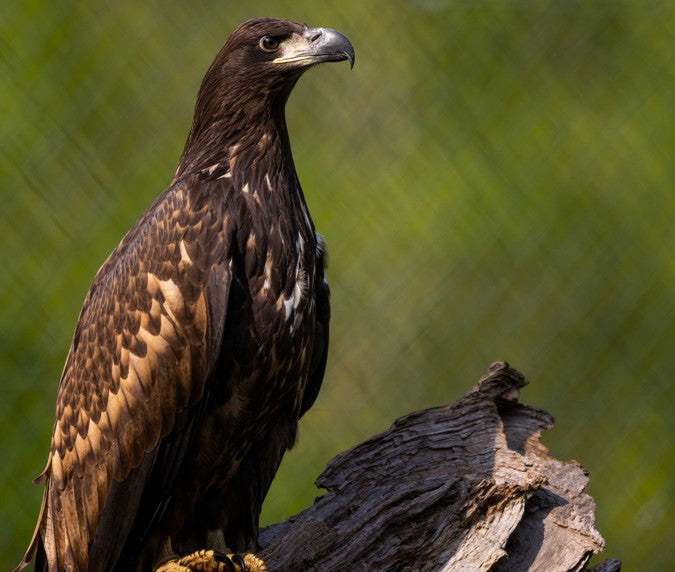
Fota Wildlife Park announces the birth of a white-tailed sea eagle chick, from a species once extinct in Ireland.
Fota Wildlife Park has announced the birth of a white-tailed sea eagle chick, in what has been an important year for endangered native species conservation at the Park. This includes the successful headstarting of curlews for release into the wild, the ongoing population augmentation programme for the natterjack toad and the captive breeding of white-clawed crayfish.
The white-tailed sea eagle chick was born on the 13th of April to the resident breeding pair, Áine and Tony, and through their attentive parenting the chick has successfully fledged. The white-tailed sea eagle is the largest eagle species in Europe, with a wingspan stretching up to 2.5 metres.

White-tailed sea eagles were once a common sight along the Irish coastline but became extinct in Ireland in the 19th century due to human intervention. They are now a Red Listed species in Ireland and are of high conservation concern.
Since 2007, the National Parks and Wildlife Service (NPWS), in collaboration with the Norwegian Institute for Nature Research and local farmers and communities, has released over two hundred white-tailed sea eagles at sites in Ireland. The programme has been so successful that the population is now self-sustaining.
Fota Wildlife Park has been part of the white-tailed sea eagle recovery programme since 1991, breeding six chicks, including this one, in support of specialised conservation efforts.
Fota Wildlife Park has also played a vital role as a partner in the Breeding Waders European Innovation Partnership (EIP) initiative. As part of this project, Fota Wildlife Park has participated in the Curlew Headstarting Programme since 2022 and, to date, has successfully reared over 90 curlew chicks for release into the wild. Curlew eggs are rescued by Nest Protection Officers from vulnerable nesting sites before being brought to Fota Wildlife Park, where the specialist conservation team incubates, hatches and rears the chicks until they are strong enough to survive in the wild.
Aileen Tennant, Director, Fota Wildlife Park, said: “The successful birth and rearing of the white-tailed sea eagle chick is another positive outcome of the specialist native species conservation work that the animal care team carries out at Fota Wildlife Park every day. The national curlew headstarting project is made possible by the Breeding Waders EIP team, NPWS, Irish Rural Link, Michael Martyn Agri-Environment, Irish Wildlife Services, Dublin Zoo, Atlantic Technological University and University College Dublin, demonstrating the value of partnership in delivering these conservation outcomes.
Through our long-running partnership with the NPWS and Dingle Oceanworld, we have helped conserve Ireland’s endangered natterjack toad through a population augmentation programme, headstarting at-risk toad spawn collected from ponds in County Kerry, and rearing toadlets for release into the wild. Since 2016, more than 13,600 toadlets have been returned to their native habitat, with a further 750 due for release this August.
In conjunction with the NPWS, Cork County Council, the National Marine Institute, and independent ecologists, we have rescued 150 endangered, white-clawed crayfish from a North Cork river threatened by crayfish plague in 2024 and have successfully bred 120 craylings. We are currently working to establish new populations to be reintroduced into protected, plague-free "ark" sites.”
Jess Hodnett, Fota Wildlife Park’s Native Species Conservation Officer, said: “These ongoing avian conservation programmes at Fota Wildlife Park are such special projects to be involved in. This white-tailed sea chick is the first chick to be born here in over a decade, and the mother and father have done a great job of hatching and rearing this fledgling. We hope this chick will take part in an ex-situ European endangered breeding programme for the species.
“We are also delighted to be an ongoing partner in the Breeding Waders EIP for the curlew. This year alone, 16 curlew fledglings were headstarted here for release to Lough Ree and Lough Corrib. Fota Wildlife Park is uniquely positioned to support this important avian headstarting work, and it hugely complements all the other species conservation work we are involved in. At this stage, we have about 10 years of expertise in headstarting projects, including with the native natterjack toad.
The process is highly specialised from the very beginning, requiring the precise conditions these vulnerable eggs need to maximise their chances of hatching and survival.
At Fota Wildlife Park, this is made possible by the combination of our specialist facilities such as the incubation house, the purpose-built rearing units and the expertise of our dedicated conservation rangers. With this unique blend of space, resources and knowledge, we can successfully contribute to avian conservation projects of national importance for the curlew and other vulnerable and endangered species.”
See www.fotawildlife.ie for more information.